


Justin R. Greenbaum · The Lexicon · May 2026
A senior staff engineer who used to flag architecture risks in design reviews has stopped. The reviews still happen, but her comments are narrower now, scoped to the technical detail in front of her. Three of her last four structural escalations were acknowledged and not acted on. A regional VP runs the all-hands, where engagement scores hold steady year over year and the questions submitted in advance are softer than last year, which she reads as alignment maturing. Two of her top three performers have quietly told their managers they are looking outside. A director of operations sends the weekly risk register up the chain. The register has not changed in eleven weeks, and the new risks she would have added six months ago no longer get added. A program manager closes a quarterly review with “whatever you decide works for us.” She means it; she no longer has a preference.
Each of these people is reading the system correctly. It has stopped responding to signal, and they have stopped sending it.
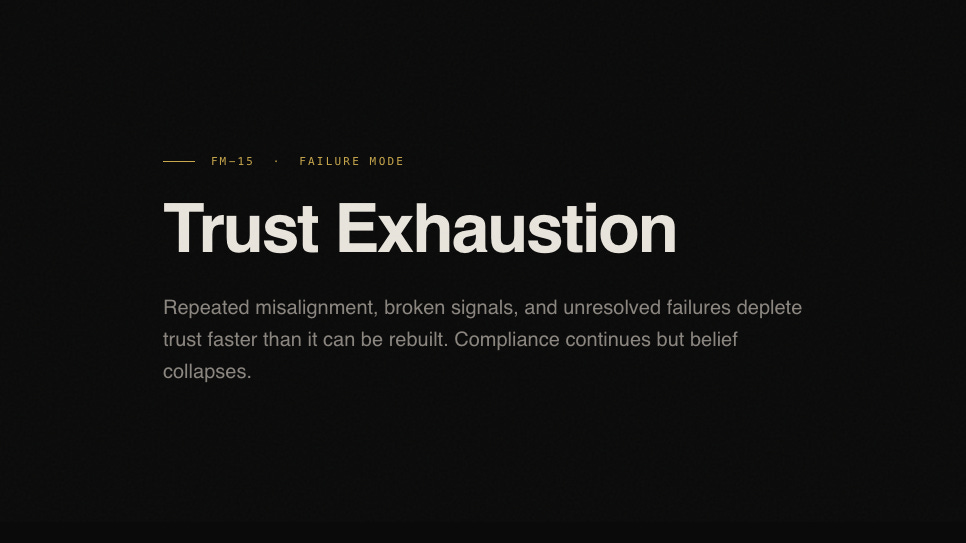
This has a name. It is Trust Exhaustion.
Here’s the pattern. Repeated misalignment and unresolved structural failures deplete trust faster than it can be rebuilt. People keep complying while belief collapses, engagement becomes mechanical, and discretionary effort disappears. The system reads the calm as alignment maturing. What it is reading is the absence of further attempts.
Compliance masquerades as alignment. The team that no longer pushes back is described as mature. The all-hands with fewer questions is called focused. The risk register that stops growing is called stabilized. The engagement survey that holds steady is treated as proof the culture work is paying off. The signal the system reads is alignment. The condition underneath is people who have stopped expecting the system to respond to truth.
What Trust Exhaustion gets mistaken for is the thing that makes it durable.
The misdiagnoses are familiar. Burnout. Generational disengagement. Change resistance. An engagement problem. Each one personalizes a structural outcome. Each one prescribes an intervention the structure already knows how to absorb. Wellness programs land on people who have already disengaged. Recognition rewards the compliance the system is mistaking for commitment. Values refreshes ask the silent to speak more clearly. None of these touch the structural failure that produced the distrust.
Compliance is how Trust Exhaustion survives contact with the engagement survey.
The pattern recurs and changes costumes. In one organization it shows up as a leadership team celebrating the absence of attrition in a quarter where the two people most likely to leave already have. In another, as an engagement survey with the same neutral midpoint year after year and a comments field that returns nothing actionable. In a third, as a culture of psychological safety where the surface stays calm and the structural failures that produced the silence are never named.
The conditions are structural, not behavioral. This is why a new manager does not restore it. A new CEO does not restore it. A team offsite does not restore it. Each of these resets the relationship at the surface and leaves the structural breach intact.
What interrupts it is structural. A visible reversal of a known bad decision, named as such. A leader paying a personal cost for the structural failure that produced the breach. A consequence for the system, not the person who reported it. Where no recent failure has been corrected visibly, the cleanest move is to stop adding new asks until at least one prior failure has been structurally repaired.
When Trust Exhaustion has a name, the options change.
The senior engineer stops reading her own quiet as professionalism and sees it as the cost the system is asking her to pay. The director above her stops adding feedback loops and starts visibly correcting the failures that produced the silence. The executive responsible for the function sees that the steady engagement score is not a culture achievement and that another round of recognition will not produce belief. The board reviewing the year sees that the absence of dissent is not the alignment it has been described as.
Naming does not fix. Naming changes what can be seen. What can be seen is what can be acted on.
If any of this feels familiar, it has a name and a taxonomy.
The canonical definition of FM-15, including its early warning signals, common misdiagnoses, and recovery conditions, is at dripractice.com/fm/fm-15.
A role-specific view of how the same pattern looks from the HR seat is at dripractice.com/lens/hr.
A five-minute diagnostic that runs entirely on your device and never leaves it is at dripractice.com/diagnose.
Next in The Lexicon: FM-05, Normalized Workarounds. It is what people do once they have stopped trusting the system to respond. They do not push harder. They route around. The workaround becomes the work.
Subscribe to The Lexicon.