


Justin R. Greenbaum · The Lexicon · July 2026
A CEO knows the company needs to place a two-year bet, but each quarter arrives with a number to defend, so the bet slides to the next planning cycle, and the one after, because the calendar only rewards what closes before it ends. A head of R&D can see the platform will be obsolete in three years, but this year’s roadmap is already full, so the rebuild never gets staffed, because work that pays off after the current tenure has no one whose bonus depends on it. A VP is celebrated for pulling three at-risk launches over the line, but why all three were at risk is never examined, because firefighting is visible and the prevention that would have made it unnecessary is not. A product leader wants to hold capacity for the market the company will need next, but the market it has is on fire, so the capacity gets spent this quarter, because urgency always outbids importance in a room with a clock on the wall.
None of these leaders are failing. Each one is trading a future they can see for a present they are measured on.
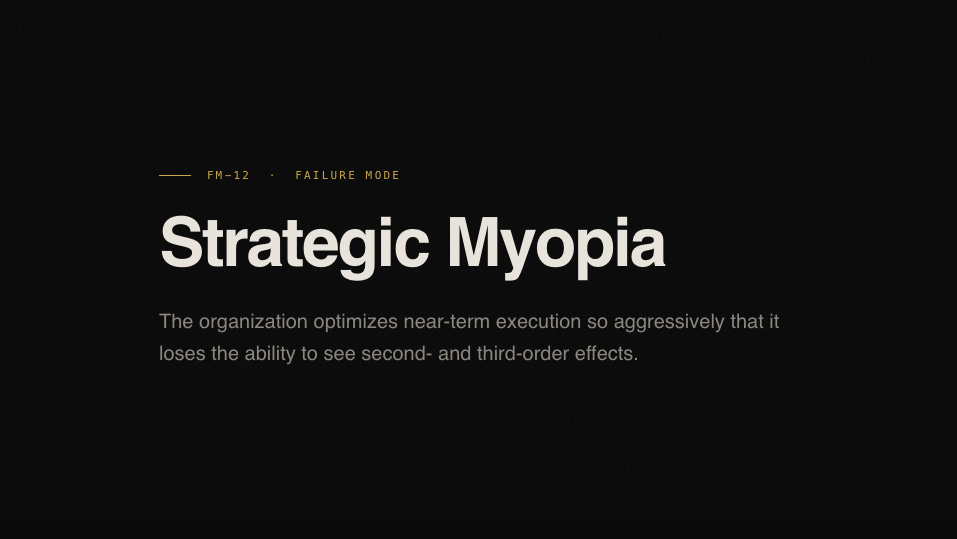
This has a name. It is Strategic Myopia.
Here’s the pattern. Under sustained pressure, an organization optimizes for what it can measure this quarter and slowly loses the ability to see past it. Strategy stops being a set of bets about the future and becomes a sequence of reactions to the present. Second- and third-order effects fall out of view. Nobody decides they no longer matter; nothing on the calendar rewards seeing them. The dashboard that was meant to track the strategy quietly becomes the strategy, and the company optimizes for what the number can see and loses the rest. It calls the narrowing focus.
Narrowing masquerades as focus. The executive who kills the long-horizon project to concentrate on the quarter is called disciplined. The team that drops the two-year roadmap to chase the current fire is called responsive. The leader who says there is no time for strategy is called a realist. The signal the system reads is focus. The condition underneath is an organization narrowing its own field of view until only the quarter is left.
What Strategic Myopia gets mistaken for is what keeps it alive. The market changed. We need to be more agile. This is just execution debt. We will fix it next quarter. Strategy is a luxury right now. Each reading treats the narrowing as a temporary response to conditions, so the repair is always to execute harder and decide later. None of them widen the horizon, so the horizon keeps closing. Hero narratives are how Strategic Myopia survives contact with the strategy offsite, the one event on the calendar meant to widen the horizon and the one most easily spent reaffirming the quarter.
The pattern recurs and changes costumes. In one company it is a research budget trimmed every year to protect the quarter until there is nothing left to commercialize. In another, a hospital so tuned to this month’s throughput that the capability it will need next decade is never built. In a third, an agency that runs on emergencies so completely that the reforms meant to end the emergencies never get scheduled.
The conditions are structural, not behavioral. A visionary offsite does not interrupt it; the horizon widens for two days and closes the following Monday. A new mission statement does not interrupt it; a slogan does not change which work gets staffed. Replacing the executive does not interrupt it; the replacement inherits the same incentives and shortens the same horizon within a quarter.
What interrupts it is structural. Run short-term and long-term decisions in separate lanes, so the future is not forced to bid against this week’s fire for the same attention. Make a named leadership role accountable for future-state health, so someone in the room loses when the horizon closes. Protect strategic work with time that urgency is not allowed to raid. Accept deliberate short-term pain where it buys long-term position, and treat the willingness to absorb it as a sign of health. Where the horizon has already collapsed to the quarter, the fail-safe is to freeze the optimization and widen the time horizon before deciding anything else.
When Strategic Myopia has a name, the options change.
The VP who has been rewarded for firefighting stops calling it performance and sees a role built to spend the future. The manager above stops praising the saves and asks why the same fires keep starting. The executive stops reading strong execution as a healthy strategy and asks what the company can no longer see. The board stops accepting “we are staying focused” and asks what focus has cost the horizon.
Naming does not fix. Naming changes what can be seen. What can be seen is what can be acted on.
If any of this feels familiar, it has a name and a taxonomy.
The canonical definition of FM-12, including its early warning signals, common misdiagnoses, and recovery conditions, is at dripractice.com/fm/fm-12.
A role-specific view of how the same pattern looks from the board’s seat is at dripractice.com/lens/the-board.
A five-minute diagnostic that runs entirely on your device and never leaves it is at dripractice.com/diagnose.
Next in The Lexicon: FM-13, Capability Atrophy. An organization that spends every quarter and invests in no year stops exercising the capabilities the future depends on. FM-13 is what happens when those muscles quietly waste.
Subscribe to The Lexicon.