


Justin R. Greenbaum · The Lexicon · May 2026
A chief product officer brings a pricing change to the leadership team. The data supports it. The customer signal supports it. The competitive window is closing. The meeting ends with a request for one more round of input from Legal, Finance, and the regional leads. A VP of engineering has approval to deprecate an internal platform. The timeline is set. Three weeks later, the migration has not started because two adjacent teams want to align on sequencing. A director of strategy presents a market-entry recommendation. The executive sponsor agrees with the analysis. The recommendation is tabled until the next offsite so the broader leadership team can weigh in. A general manager greenlights a headcount reallocation. HR, Finance, and the COO’s office each ask for a briefing before the req is posted. The req is never posted.
None of these people lack authority. Each one holds the title, the mandate, and the budget. What they lack is permission to use it without asking.
This has a name. It is Decision Latency.
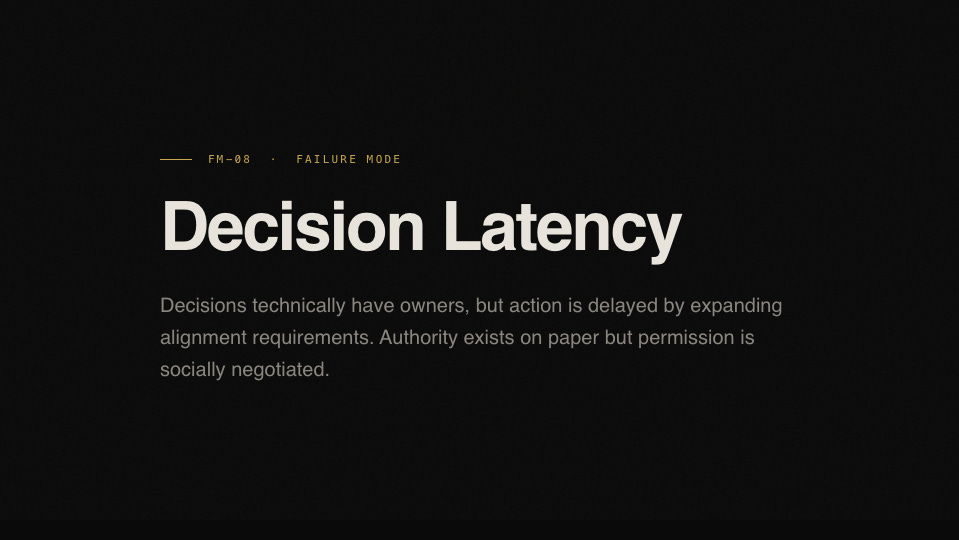
The pattern is this. Decisions technically have owners, but action is delayed by expanding alignment requirements. Input is continuously gathered, socialized, validated, and revalidated. Authority exists on paper, but permission is socially negotiated. The system does not block decisions. It absorbs them.
Alignment masquerades as governance. The meeting that ends with “let’s get everyone on the same page” is praised as inclusive. The leader who pauses to build consensus is described as thoughtful. The process that routes a decision through four review layers is called mature. The signal the organization reads is care. The condition underneath is a system that has made deciding more expensive than waiting.
What Decision Latency gets mistaken for is the thing that makes it durable.
The misdiagnoses are generous. Strategic depth. Thoughtfulness. Inclusivity. Strong governance. Each one treats the delay as a feature. Each one rewards the behavior that is slowing the system down. Leadership coaching teaches patience the structure is exploiting. Process improvement adds gates to a pipeline already full of gates. Governance frameworks formalize the very alignment loops that replaced the decision.
None of these substitute for authority exercised. An organization cannot move faster by adding more people to the conversation. A leader cannot decide what the culture has made expensive to decide. A process cannot substitute for a person willing to be wrong.
Consensus is how Decision Latency survives contact with the board.
The pattern recurs and changes costumes. In one organization it shows up as a RACI matrix where every stakeholder is consulted and none are accountable. In another, as a culture of psychological safety where disagreement is welcomed and resolution is not. In a third, as agile governance where decisions are distributed to committees that meet biweekly and decide monthly.
The conditions are structural, not behavioral. This is why faster meetings do not interrupt it. Better decks do not interrupt it. More data does not interrupt it. Each of these speeds up a process whose purpose has become avoiding the decision, not making it.
What interrupts it is structural. Clear deadlines with consequences for missing them. Named deciders with reversal authority. Separation of input from approval. Cultural permission to decide with incomplete information. Where the decision rights cannot be clarified, the cleanest move is to escalate once, visibly, rather than let the alignment loop run until the window closes.
When Decision Latency has a name, the options change.
The product leader stops treating the fourth alignment meeting as due diligence and sees it as the system avoiding a commitment. The VP above her stops adding reviewers and starts naming deciders. The executive responsible for the function sees that the missed window was not a planning failure and that another governance layer will not restore speed. The board reviewing the quarter sees that no amount of strategic patience will produce results until someone is permitted to act.
Naming does not fix. Naming changes what can be seen. What can be seen is what can be acted on.
If any of this feels familiar, it has a name and a taxonomy.
The canonical definition of FM-08, including its early warning signals, common misdiagnoses, and recovery conditions, is at dripractice.com/fm/fm-08.
A role-specific view of how the same pattern looks from the product leader’s seat is at dripractice.com/lens/product.
A five-minute diagnostic that runs entirely on your device and never leaves it is at dripractice.com/diagnose.
Next in The Lexicon: FM-15, Trust Exhaustion. It is what happens after enough decisions stall. The people who used to push for resolution stop pushing. They have learned that the system does not reward it.
Subscribe to The Lexicon.