

Coherence is a property of a system in which truth, authority, and continuity reinforce each other over time, reducing the need for corrective effort.
When systems lose coherence, people absorb the cost.
I didn’t find this in a book. I found it by living inside complex systems for twenty years, noticing the same patterns, and writing to make sense of them. The framework didn’t arrive fully formed. It crystallized slowly, through attention, through failure, through watching what held and what didn’t.
This is what I’ve been working toward. Not a theory to defend, but a way of seeing that finally has a name.
The Triangle
Three vertices. Three things that have to hold together.
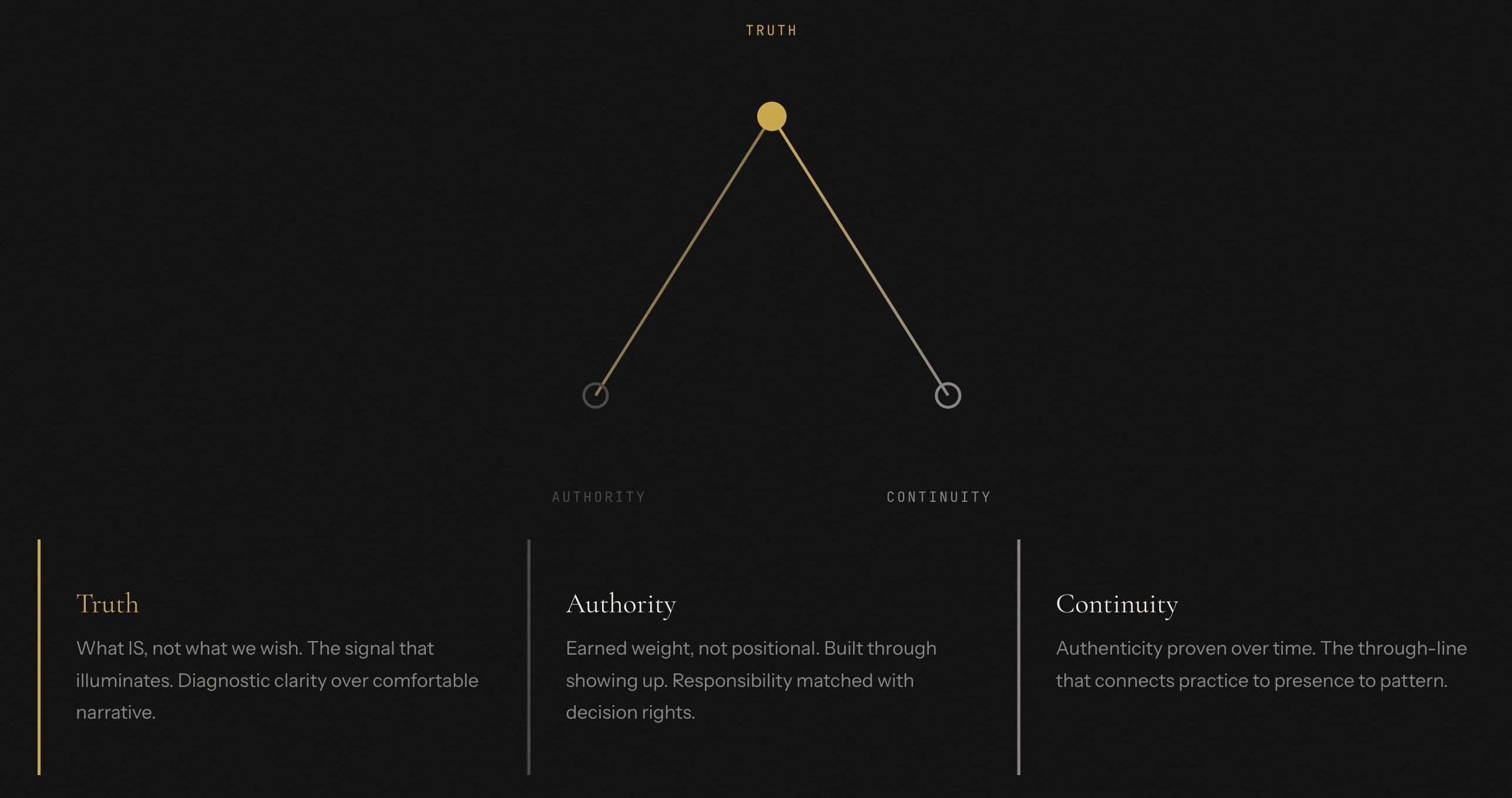
Truth — what actually is, not what we wish or what we report. The signal, not the story we tell about the signal. In operations, this is the difference between what the dashboard shows and what’s actually happening on the floor. In medicine, it’s the difference between the chart and the patient.
Authority — not positional power, but earned weight. The kind that comes from showing up, from being right when it mattered, from carrying responsibility visibly over time. A frontline supervisor who flags a process gap. A nurse who speaks up. A junior analyst who catches the error.
Continuity — authenticity proven over time. The through-line that lets people trust the pattern will hold tomorrow because it held yesterday. This is why teams with shared history outperform teams with more talent. The pattern is known. The gaps are covered.
When all three vertices are honest, the triangle holds. When one drifts, the others compensate. When two drift, the structure strains. When all three are compromised, coherence breaks, and humans absorb the gap.
The Flow
This is how the work moves:
Lived Practice → The ground. Real operations, real pressure, real decisions. This is where truth originates, not in frameworks or models. You learn what works during the outage, not during the planning session.
Presence & Trust → Before any framework lands, you have to demonstrate attention. Show continuity. Establish safety. No teaching. No agenda. Just showing up. This is why the best leaders listen before they speak.
Shared Language → Name what people already recognize. Reduce ambiguity. Create alignment without instruction. The aviation industry calls this “crew resource management.” The military calls it “commander’s intent.” In operations, it’s the playbook everyone actually trusts. The words should feel like relief, not education.
Observation → Capture early signals. Notice drift before failure. The goal is to preserve ambiguity long enough to understand it, not to force conclusions. Good incident review does this. Bad incident review assigns blame.
Diagnosis → Name the repeatable breakdowns. Create durable reference language. Support people under pressure with patterns they can recognize and address. A shared vocabulary for what’s going wrong.
Orientation → The loop closes. When signals appear again, the language exists. The diagnosis is available. No rediscovery required. This is how institutions learn, when they learn at all.
The Diagnostic Lens
What I watch for:
Early signals (Functional Field Notes)
Signal Misread — the data is there but the interpretation drifts. The dashboard is green but the phones are ringing.
Responsibility Compression — ownership narrows as pressure increases. One person becomes the load-bearing wall.
Context Collapse — decisions made without necessary background. The person deciding doesn’t know what the person executing knows.
Meaning Drift — words stay the same but their meaning shifts. “Escalation” means something different to everyone in the room.
Breakdowns (Failure Modes)
Responsibility Without Authority — you own the outcome but not the decision. Common in operations, common in healthcare, common everywhere matrices exist.
Metric Shadowing — the measure becomes the target, obscuring what it was meant to illuminate. Goodhart’s Law in action.
Escalation Theater — the process exists but doesn’t function. Everyone followed the steps. Nothing was addressed.
Decision Displacement — choices pushed to people without context to make them. The frontline shouldn’t be setting policy during an outage.
The crosswalk between early signals and failure modes is where intervention is possible. Once a signal hardens into a failure mode, the cost is already being paid.
Where This Shows Up
These patterns aren’t theoretical. They appear in:
Operations & CX — when the escalation path exists on paper but collapses under pressure. When frontline teams see the problem but the structure doesn’t support surfacing it. When metrics tell one story and customers tell another.
Healthcare — when a nurse sees something wrong but the hierarchy discourages speaking up. When handoff protocols exist but context doesn’t transfer.
Aviation — when crew resource management fails and copilots defer to captains against their own judgment. When checklists become ritual instead of verification.
Any system where stakes are high and information is incomplete.
The pattern is the same. The cost is always human.
What This Is
I spent a long time not knowing what to call this work.
I knew I was noticing something. I knew the patterns were real. I wrote to try to make sense of them, revised, threw things out, started again. It took years to find language that didn’t feel borrowed or forced.
Coherence is what I arrived at. A diagnostic framework. A way of seeing where systems are holding and where they’re drifting.
It applies to organizations. It applies to teams. It applies to decisions you make alone at 2am when the information is incomplete and the stakes are real.
The work is noticing where truth, authority, and continuity are pulling apart, naming it clearly, and creating the conditions where it can be addressed.
This is what I’m building now. Not because someone asked for it, but because the pattern finally has a name and I can’t unsee it.
Coherence is the cornerstone. Authenticity is continuity proven over time.
Explore the interactive version: justingreenbaum.com/coherence
More on how I’m building this infrastructure: greenbaumlabs.com