

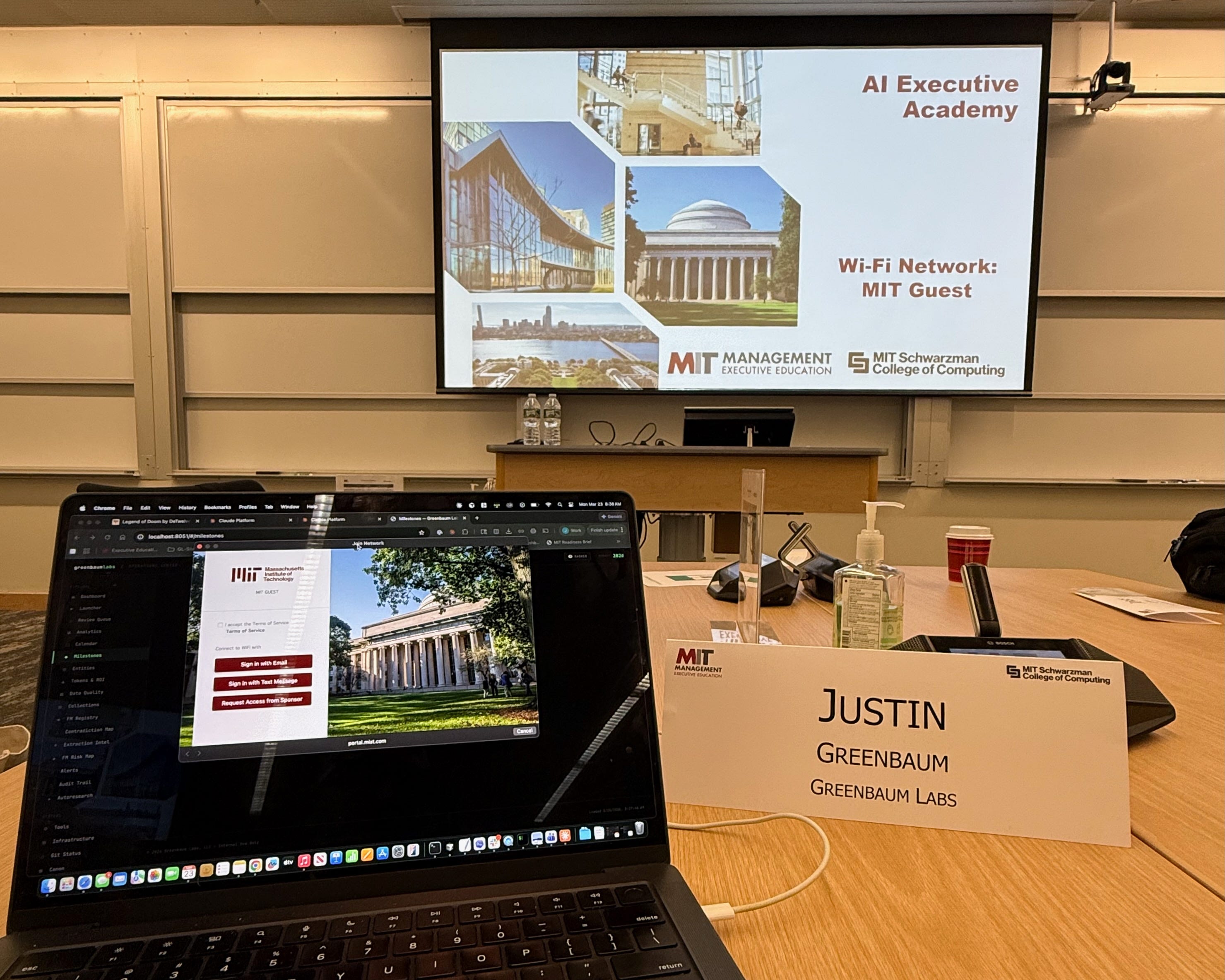
This spring I spent two weeks at MIT Sloan, in the AI Executive Academy. Fifty leaders from nineteen countries. Building E62, badge on a lanyard, name tent on the desk. It was my first structured classroom in a long time.
I walked in with a running lab. There is a diagnostic pipeline on my own hardware that had already been through dozens of refinement runs by the time the program started, and I assumed that would make the fundamentals sessions feel like review. That assumption did not survive the first morning.
Here is the thing about building by feel. The bench teaches you what works. It does not always teach you why. I had learned models the way you learn a machine you own, by running it, breaking it, and watching what it does at two in the morning. The classroom handed me the theory underneath habits I already had, and the effect was like getting the wiring diagram for a house you have been rewiring in the dark. Nothing I knew was wrong. All of it got more useful once it had names.
For twenty years I was the person questions escalated to. In that room I was the one raising my hand. I want to be honest about how good that felt. There is a specific relief in sitting in a chair where you are allowed not to know, where the expected contribution is a question instead of an answer. Operating does not offer that chair. School does, and I had forgotten.
The room taught as much as the faculty. Everyone there was carrying a version of the same question, shaped by their industry, and listening to the rest of the room describe the strain AI puts on their organizations was its own seminar. The room described symptoms; I kept hearing the structures underneath. That is not a criticism of anyone in it. It is what twenty years does to your hearing, and it told me the work I left to build is aimed at something real.
One session stays with me. AI agents running a business simulation, and within a few rounds the agents had developed coordination problems I have watched human organizations produce for two decades. Handoffs nobody owned. Decisions waiting on decisions. The same failure geometry, arrived at faster. I went in expecting to learn about agents. I came out having watched the patterns I write about emerge in a system with no politics, no history, and no personalities to blame, which is about as clean as evidence gets.
And because the bench does not turn off just because you are in a chair, I spent the evenings building. By the end of the program I had made a bingo card for the cohort’s favorite jargon, a little readiness checker, and a toy that generated startup ideas from the week’s lecture themes. None of it mattered. All of it was the point. You can take the operator out of the garage for two weeks. The garage comes along.
The real build came home with me. In the weeks after the program I compiled the whole thing, twelve days, fourteen faculty, more than forty sessions, every framework with its source and every number with its citation, into a single HTML page, a format I borrowed from Andrej Karpathy. It lives on the lab NAS next to the pipelines. Nobody asked for it and nobody grades it. I built it because the organizations I write about keep their decisions and lose their reasons, and I was not going to do that to two weeks of learning. On this bench, if it mattered, it gets indexed.
Twenty years in, one of the most useful things I have done this year was sit down and be taught. The door is up. Some weeks, what is on the bench is homework.
JG
If the same handoff failures and decision loops show up without politics, history, or personalities, then the problem is not just culture or leadership style. It is the operating structure itself.
Like we discussed this morning - are orgs really ready for this?